
In private testing before release
For the prayers that aren’t tidy
Built on the four-part shape the psalmists used when they had nothing polished to say. Roughly a third of the Psalms are laments, and that structure is unusually good at holding grief.
Tell us which phone you use, and we’ll send the right invitation or tell you when there is one.
What’s inside
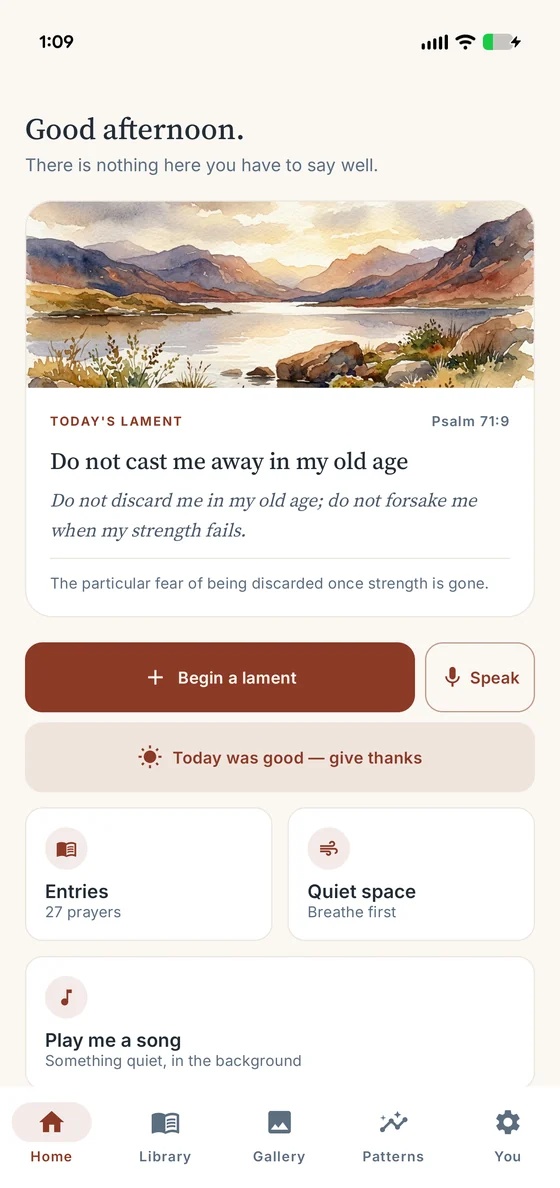
It opens on a passage, not an empty page
Three things carry the app: something to sit with, a structure to write into, and someone who has already been where you are.
A lament a day
Forty-two passages, weighted toward the hard ones, each with a note on what the psalmist is doing. Not a verse lifted out of context to encourage you.
A guided composer
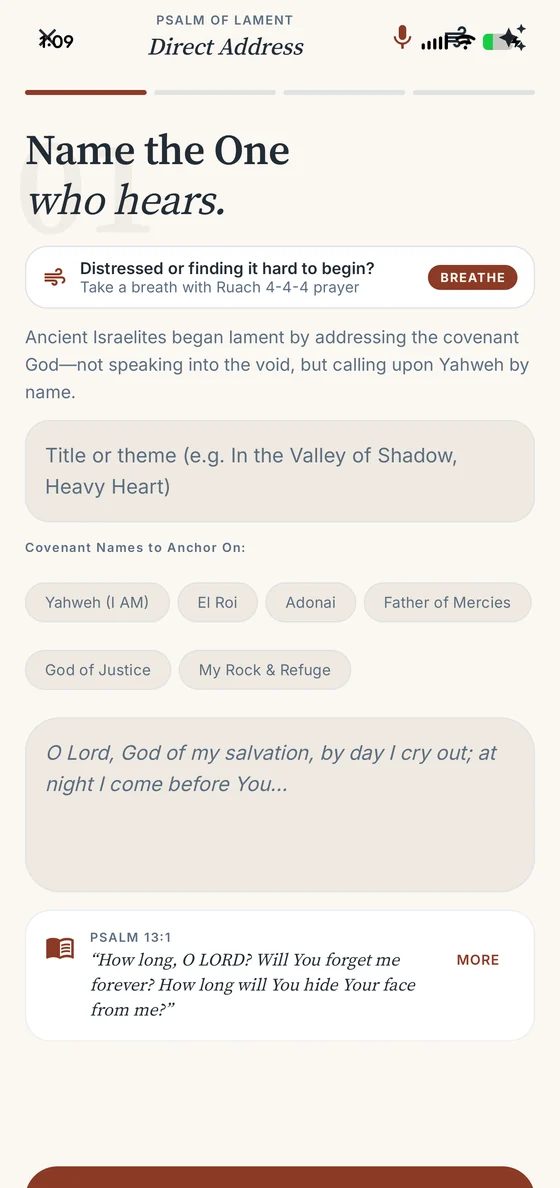
Four movements, autosaving as you write, so a phone call in the middle of a hard entry doesn’t cost you the entry. You can stop anywhere and keep what you have.
Company in it
Elijah under the broom tree, Hannah at Shiloh, Jeremiah in the cistern, Job on the ash heap — matched to what you actually wrote, not to a mood you picked from a list.
The structure
The four movements
The order is the idea, not decoration. It gives you somewhere to put the complaint without demanding you resolve it — and the composer walks you through one movement at a time.
-
Address
Say who you are talking to. The psalms almost never open with the problem — they open with the name.
-
Complaint
The unedited version. What is actually wrong, in the words you would use if nobody were listening.
-
Request
Ask for something specific. The lament psalms are startlingly blunt here, and the app does not soften it for you.
-
Trust
Most laments turn toward hope. Psalm 88 never does. If today is a Psalm 88, leave this one empty — the entry is still whole.
See it
The same four parts, walked through
Two minutes, showing the movements in the app rather than describing them.
The daily passage
Here is today’s, in full
This is what opens when you start the app — a piece of a real lament, on its own terms.
How long?
How long, O LORD? Will You forget me forever? How long will You hide Your face from me? How long must I wrestle in my soul, with sorrow in my heart each day? How long will my enemy dominate me?
Four questions, no answer offered. The complaint is allowed to be the whole prayer for a while.
Scripture is never generated. The whole Berean Standard Bible ships inside the app, so every verse you see is looked up rather than written — a language model is asked which passage fits, never what it says.
Your journal
Still here in ten years
A phone gets lost, dropped, stolen or replaced; the journal shouldn’t go with it. Your entries are kept in your account and come back when you sign in somewhere new.
Readable by you
Isolated to your account by the database itself, not by the app asking nicely, and encrypted at rest. Nothing here reads what you wrote — no analytics, no training, nobody. Exactly how your journal is held.
Never the product
Nothing sold, nothing shared with advertisers, nothing used to train a model. No advertising, ever. Nothing is uploaded for a reflection unless you tap to ask.
Yours to take
An encrypted backup or a plain PDF, whenever you want. Lock the app with your phone’s screen lock, or with a PIN of its own that your phone never stores. Deleting your account really deletes it.
What it costs
Writing is free, and stays free
The composer, the daily passage, unlimited entries and encrypted export have no price. Putting a paywall between someone and a prayer would be exactly the wrong thing to do.
A subscription covers the parts that cost real money to run: your words shaped into a psalm, someone in scripture who has been where you are, three hundred reflections and fifteen watercolours a month, and patterns across your journal. No advertising, ever, and nothing that depends on reading what you wrote.
None of it is on sale yet. While Lament is in testing nothing in the app asks you for money, and nobody is charged for anything.
Trust in Him at all times, O people; pour out your hearts before Him. God is our refuge. Psalm 62:8 · Berean Standard Bible
Lament is a journal, not care. It is not a substitute for a doctor, a counsellor, or a pastor — so crisis support is reachable from anywhere in the app. If you are in danger, please contact your local emergency services; in the United States, the 988 Suicide & Crisis Lifeline, by call or text.